in the shadow of the sword
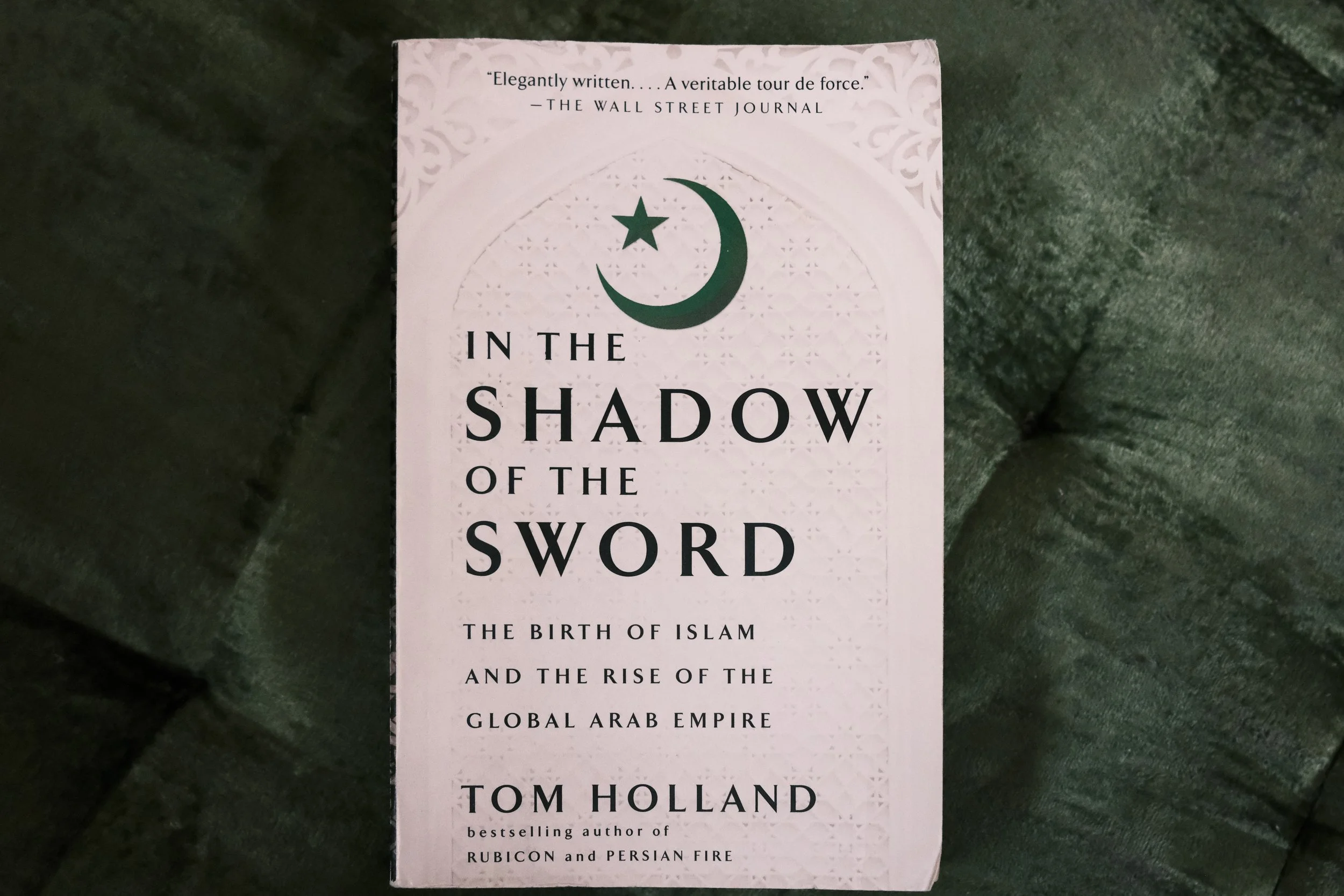
As the last of the three Abrahamic religions to arrive on the world stage, Islam is traditionally considered by academic scholars to have been “born in the full light of history.” The founding of Islam occurred centuries after the completion of the Old and New Testaments, benefiting from the work of Jewish and Christian scholars whose ultimate achievement was “to craft an interpretation not only of their own various forms of monotheism but of religion itself.” The author argues that the emergence of Islam in the seventh century therefore not only contributed to the end of late antiquity, but embodies its culmination.
The author also challenges this “full light” understanding and asserts that the birth of Islam is instead shrouded in an “almost impenetrable darkness.” He questions the veracity of Islamic religious texts that provide the foundation for Muslim tradition and relies on his knowledge of neighboring empires (Persia and Rome) and their regional influence in order to establish his own speculation. The author focuses on Mesopotamia and the Levant rather than the Arabian peninsula to suggest that Mecca is not the true birthplace of Islam. The application of secular scholarship to traditional religious understanding by a non-practitioner is bound to attract attention and generate controversy - this effort has succeeded on both counts.
The Qur’an, the holy book that is understood to be the word of Allah, shares in writing the verbal message that was revealed in its entirety by God to the Prophet Muhammad through the angel Gabriel. This occurred over the duration of two decades at the beginning of the seventh century and resulted in the understanding that the Qur’an is eternal and not created; divine, not a reflection of God.
The spiritual, moral, and political teachings derived from the Qur’an subsequently spread and helped establish an expansive empire (in the form of four successive caliphates) that stretched west from Mecca to North Africa and the Iberian peninsula, and east through Persia to Afghanistan, enduring for centuries and greatly influencing not only the beliefs and behavior of people over a vast geographic area but the eternal destiny of their souls as well. This group of believers subsequently grew into a truly global community (the most populous Muslim-majority country today is Indonesia).
Prior to the birth of Islam, Arab tribesmen maintained nomadic lives in the desert of the Arabian Peninsula, near the two aforementioned great powers: Rome and Persia. The (military) services of the nomads were often requested by the two empires, who frequently fought each other for dominion and influence over territory at the periphery of their borders.
Rome and Persia, according to the author, laid the foundations for a world in which “the yearning to fathom the purposes of a single god had become universal, and Gabriel a name on everybody’s lips.” The Jews, Christians, Zoroastrians, Samaritans, and Gnostics who could be found living and worshipping within these empires all had concepts (regarding the messiah, the world divided into warring factions of good and evil, “no god but God,” the possibility for a revelation of the divine to descend via angels to chosen mortals) that are found in the Qur’an, which supports the author’s argument that Islam was influenced by and benefited from the results of developmental struggles of the region’s religions that had been founded earlier.
Whereas Christ is considered divine in the Christian faith, the record of his life documented in the Bible is not. In Islam, the opposite is true: the Prophet’s revelations are considered divine, but the Prophet himself is no more than a messenger. However, in the “Messenger of God,” Allah had informed the faithful that “you have an excellent example to follow,” a role model whose “pattern of behavior” is “fit to serve all mankind, all eternity.” The hadiths (maxims of the Prophet), isnads (struts and supports of the hadiths), sunnah (laws to regulate), as well as the biographies of Muhammad all serve to complement the Qur’an and demonstrate how the Prophet’s behavior should be emulated.
A tradition that “attributes the origins of the Qur’an… to an illiterate man living in a pagan city in the middle of the desert,” the author writes, is unlikely to “strike those historians raised in the traditions of secular scholarship as entirely satisfactory.”
notes:
“scholarship, like nature, abhors a vacuum.”
the four caliphates: Rashidun (632-661), Umayyad (661-750), Abbasid (750-1517), Ottoman (1517-1924)